Viburnum
 |  |
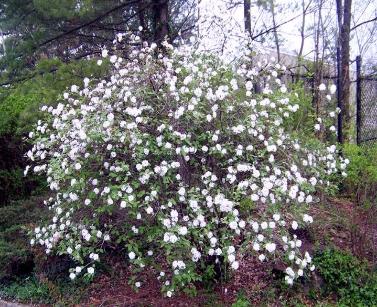
| Viburnum is a genus of about 150-175 species of shrubs or (in a few species) small trees in the moschatel family, Adoxaceae. They are native throughout the temperate Northern Hemisphere, with a few species extending into tropical Montane regions in South America and southeast Asia. In Africa, the genus is confined to the Atlas Mountains. The leaves are opposite, simple, and entire, toothed or lobed; cool temperate species are deciduous, while most of the warm temperate species are evergreen. The fruit is a spherical, oval or somewhat flattened drupe, red to purple, blue, or black, and containing a single seed; some are edible for humans (though many others are mildly poisonous to people). With the possible exception of Rhododendron, no genus offers as many attractive and useful shrubs as Viburnum. Viburnums prefer rich, evenly moist, slightly acid soil and generally flower most abundantly in full sun. |
Viburnum "Carlesii"
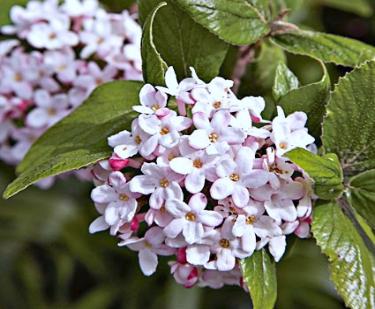
This is one of the most gloriously fragrant shrubs known to man. The dense flower heads, which
measure up to 3in across, produce white flowers from blush pink buds, and the perfume, which is a
sweet, rich, spicy vanilla, carries a considerable distance across a lawn or garden. Plant one or two
where you take your springtime strolls. Tight growth habit. Deer resistant!
This is one of the most gloriously fragrant shrubs known to man. The dense flower heads, which
measure up to 3in across, produce white flowers from blush pink buds, and the perfume, which is a
sweet, rich, spicy vanilla, carries a considerable distance across a lawn or garden. Plant one or two
where you take your springtime strolls. Tight growth habit. Deer resistant!
Viburnum plicatum tomentosum "Doublefile Viburnum
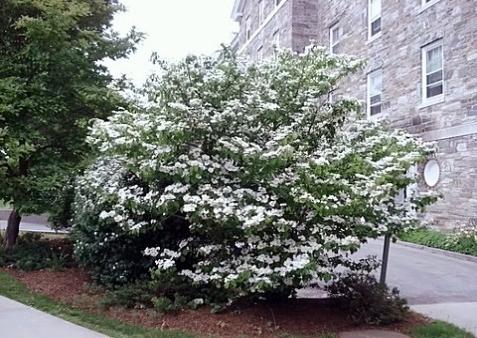
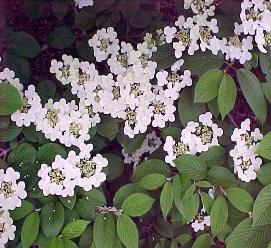
Viburnum plicatum tomentosum 'Mariesii' - the most popular variety, maturing at about 8' tall by 10'
wide, with a 45 degree angle to the horizontal in its graceful branching, and eventually with a
herring-bone arrangement of lateral stems along the angled main branches, both of which give rise
to a dense display of beautiful white flowers in early May, usually with sparse to non-existent red
fruits in a double file above the stems; leaves hang pendulous on either side of the branches for a
"dog-ear" effect; one of the best Viburnums for our area. Beautiful purple fall leaf color.
Deer resistant!
Viburnum plicatum tomentosum 'Mariesii' - the most popular variety, maturing at about 8' tall by 10'
wide, with a 45 degree angle to the horizontal in its graceful branching, and eventually with a
herring-bone arrangement of lateral stems along the angled main branches, both of which give rise
to a dense display of beautiful white flowers in early May, usually with sparse to non-existent red
fruits in a double file above the stems; leaves hang pendulous on either side of the branches for a
"dog-ear" effect; one of the best Viburnums for our area. Beautiful purple fall leaf color.
Deer resistant!